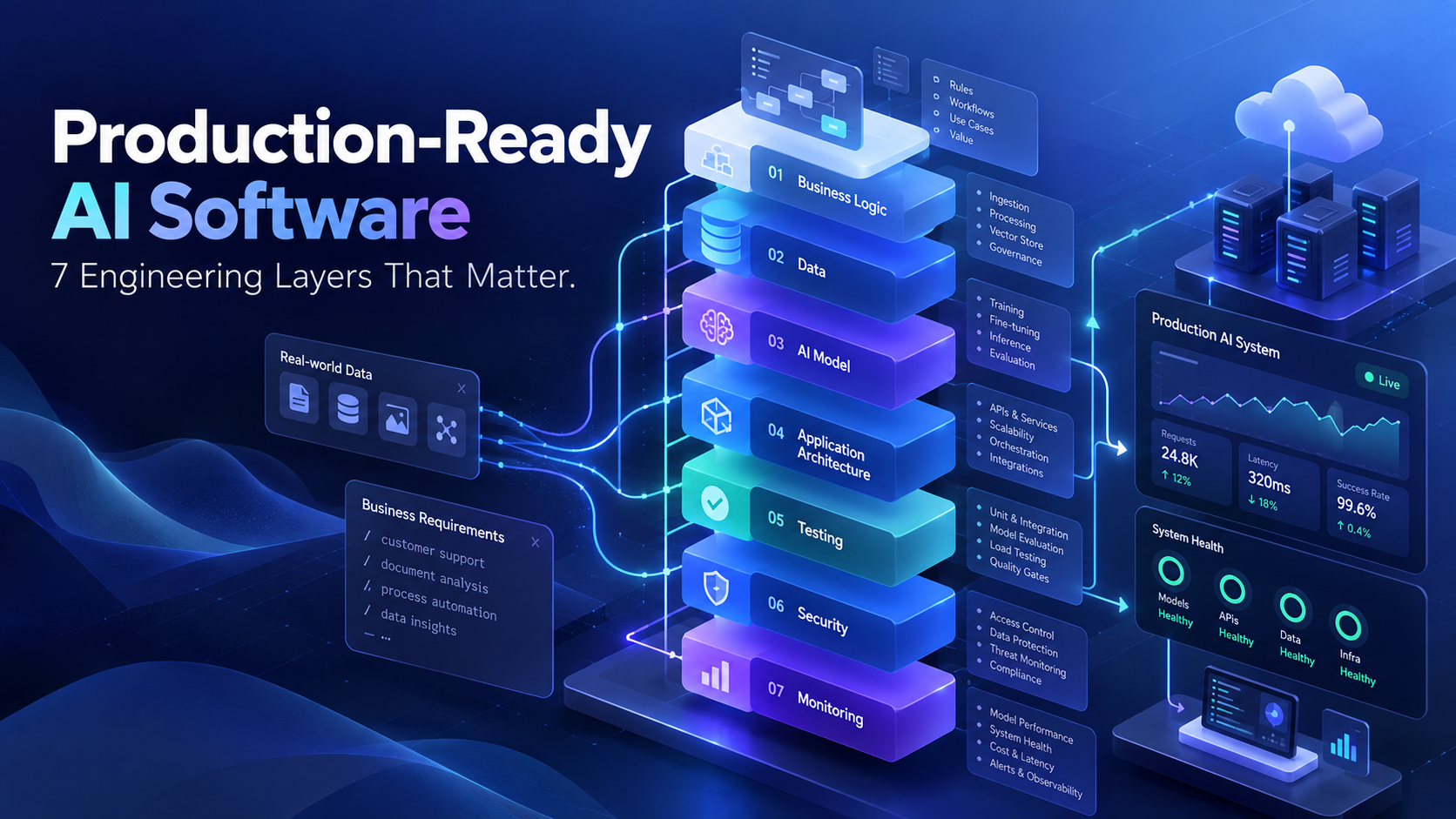
Building an AI prototype is relatively easy.
Building AI software that can reliably serve real users, connect with business systems, protect sensitive data, and continue working at scale is much harder.
That difference is what separates an AI demo from production-ready software.
A successful AI application needs more than a model and an API call. It requires a complete engineering foundation.
Here are seven layers that matter most.
Every AI system should begin with a defined business problem.
Before choosing a model or platform, teams should understand:
Without clear business logic, AI projects can become impressive technically but difficult to use operationally.
The goal should not be to “add AI.”
The goal should be to solve a measurable business problem.
AI systems depend heavily on data quality.
The application may need information from:
Production systems need reliable pipelines to collect, clean, transform, and deliver that information.
Poor data can create inaccurate outputs even when the AI model itself performs well.
This makes data architecture one of the most important parts of AI software development.
Not every use case needs the largest or most expensive model.
Teams should evaluate models based on:
A customer support assistant may have different requirements from a document-processing system or AI sales agent.
Production-ready software often uses different models for different tasks rather than depending on one model for everything.
The AI model is only one component of the application.
The surrounding software may include:
The architecture needs to handle failures gracefully.
For example, what happens if:
Production systems need fallback logic and clear error handling.
Traditional software testing is still essential.
Teams should test:
But AI systems require another layer.
The output itself must also be evaluated.
Teams may need to check:
This makes AI quality assurance different from traditional application testing.
A system can technically work while still producing poor-quality answers.
AI applications often interact with sensitive business information.
That means production systems need controls such as:
AI agents may also need limits on what actions they are allowed to perform.
For example, an agent might be allowed to draft an invoice but require human approval before sending it.
Strong guardrails make AI systems safer and easier to operate.
Launching the application is not the end of the project.
Production AI systems need continuous monitoring.
Teams should track:
AI behavior can also change when models, prompts, business data, or integrations are updated.
Monitoring helps teams detect problems before they affect large numbers of users.
An AI prototype may prove that an idea is possible.
Production software has to prove that the idea is reliable.
The difference is engineering.
Businesses investing in AI software development services should consider the full system rather than only the AI model.
That includes architecture, integrations, testing, security, monitoring, and ongoing maintenance.
Real applications operate under unpredictable conditions.
Users may provide incomplete information.
External APIs may fail.
Systems may experience traffic spikes.
AI responses may occasionally be inaccurate.
Production-ready applications are designed around these realities.
Instead of assuming everything will work perfectly, engineers plan for what happens when something goes wrong.
That is what makes software resilient.
AI software becomes valuable when it can operate consistently in real business environments.
A production-ready AI system needs:
The AI model may power the intelligence, but engineering makes the system dependable.
For businesses planning custom AI applications, the strongest results come from treating AI as part of a complete software system rather than as a standalone feature.