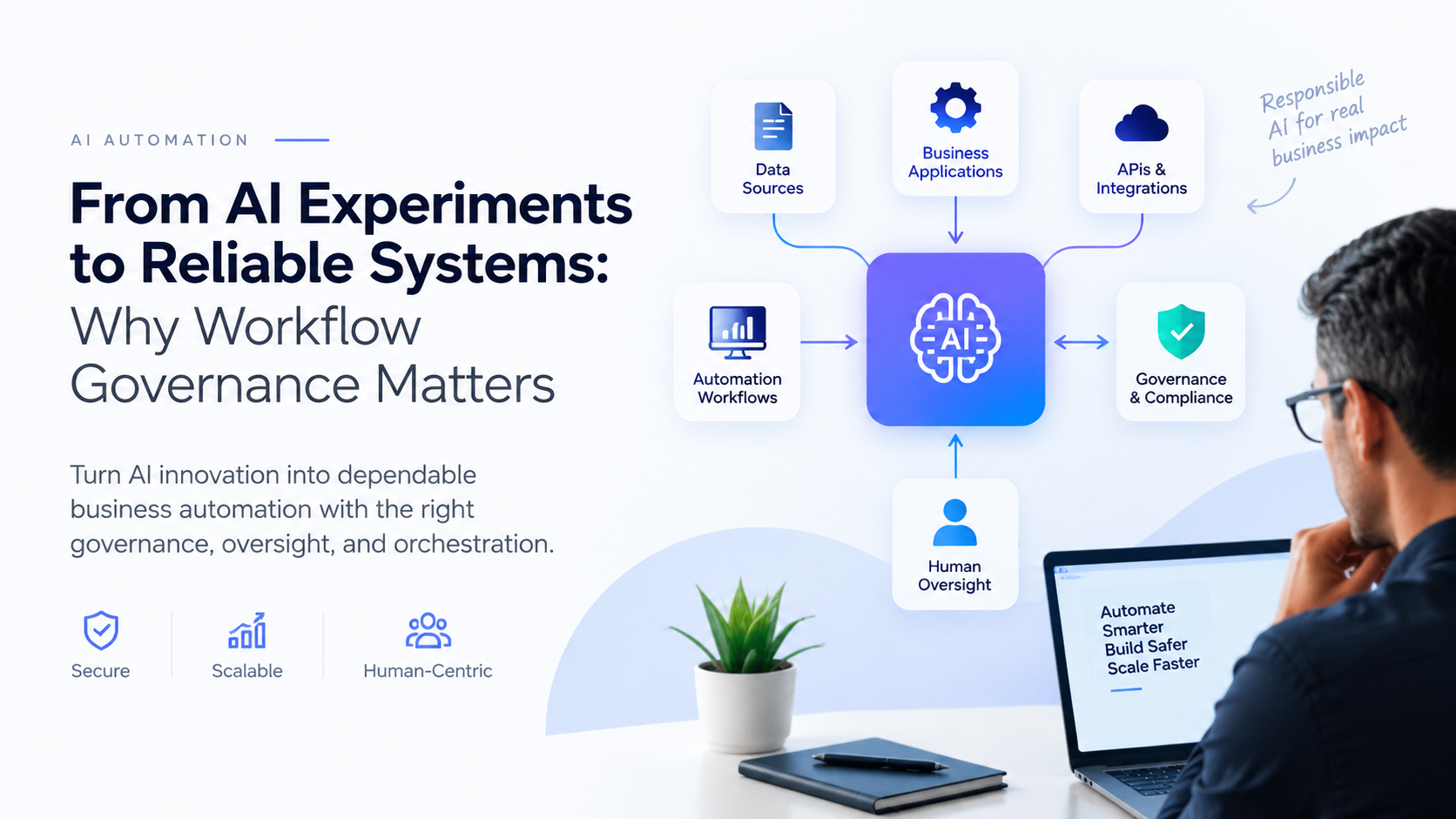
Artificial intelligence is moving beyond isolated chatbots and experimental tools. Businesses are beginning to connect AI models with CRMs, databases, internal applications, APIs, customer-support platforms, and operational workflows.
That shift creates an important challenge.
It is relatively easy to demonstrate that an AI model can perform a task. It is much harder to ensure that the same task can be performed reliably, repeatedly, securely, and with appropriate oversight inside a real business environment.
This is why workflow governance is becoming an important part of enterprise AI adoption.
Early AI implementations often focused on individual capabilities.
A company might use AI to summarize documents, generate emails, classify support tickets, analyze customer feedback, or answer internal questions.
These applications become considerably more complex when AI is allowed to trigger actions.
Consider a customer-support workflow:
Customer Request → AI Classification → Data Retrieval → Recommended Action → System Update → Response
The AI model interprets the request. APIs retrieve information. Business rules determine which actions are permitted. Connected applications execute those actions.
At this point, AI is no longer simply generating information. It has become part of an operational system.
An AI model may be capable of completing a task without being reliable enough to execute that task autonomously.
What happens when required information is missing? What if an API becomes unavailable? What if the model is uncertain about its recommendation? What if the requested action requires authorization?
Production automation needs clear answers to these questions.
Reliable AI therefore requires more than an intelligent model. It requires an architecture surrounding that intelligence.
Governance should not be documentation added after an AI system has already been deployed.
Instead, governance can become part of the workflow itself.
The system should determine:
This makes governance an operational component of automation rather than an administrative afterthought.
Not every automated action carries the same level of risk.
Low-risk activities such as document classification, internal summaries, or request routing may be suitable for automatic execution.
Medium-risk activities might require additional validation or confidence thresholds.
High-impact actions involving financial transactions, sensitive information, account changes, or important customer decisions may require explicit human approval.
This creates a practical balance between automation and control.
Human-in-the-loop automation does not mean employees need to approve every action.
Instead, workflows can escalate situations where human judgment provides the most value.
For example:
High confidence + low risk → Execute automatically
Low confidence → Request validation
High impact → Require approval
Unexpected condition → Escalate to a person
This allows routine operations to move quickly while keeping people involved in consequential decisions.
As workflows involve more AI models, agents, APIs, applications, and data sources, organizations need a mechanism for coordinating them.
That is where orchestration becomes important.
Our earlier discussion of AI orchestration for modern automation explores how AI, APIs, applications, workflows, governance controls, and human review can operate as parts of a connected architecture.
Orchestration determines how work moves through the system, while governance determines what the system is allowed to do.
Together, they create a stronger foundation for production AI.
Governance becomes particularly valuable when AI is connected with real operational systems rather than used as a standalone assistant.
Businesses may want to automate lead processing, customer support, reporting, document handling, CRM updates, marketing operations, or internal workflows. These processes often involve several applications and different levels of authorization.
Organizations implementing these types of workflows can use specialized AI business automation solutions to connect existing systems with intelligent workflows while incorporating integration, testing, monitoring, and operational controls. CodeAutomation's service offering includes AI-powered workflow automation, CRM automation, predictive analytics, customer-support automation, and broader process automation.
The objective should not simply be to automate more tasks. It should be to automate the right tasks within clearly defined boundaries.
Traditional software monitoring focuses heavily on uptime, response times, errors, and infrastructure performance.
AI-driven workflows introduce additional questions.
Organizations may need to know which information an AI system received, which tool it selected, what action it initiated, whether that action succeeded, and whether human intervention occurred.
Without this visibility, complex AI automation can quickly become difficult to understand.
Important automated workflows should leave useful records.
A typical execution history might look like:
Trigger → Input → AI Decision → Validation → Tool Call → Result → Human Intervention → Final Outcome
This information helps engineering teams investigate failures and allows operations teams to understand unusual outcomes.
It also creates greater accountability as automation expands across an organization.
AI demonstrations normally showcase the ideal workflow.
Production environments are different.
APIs time out. Authentication expires. Data may be incomplete. External platforms become unavailable. AI output may fail validation.
Reliable automation therefore requires explicit failure paths.
For example:
API Failure → Retry → Fallback → Notify Operator
Or:
Invalid AI Output → Stop Execution → Request Human Review
Building these paths before deployment makes automated systems significantly more resilient.
Organizations do not need fully autonomous AI systems to gain meaningful benefits.
A more practical progression is:
Stage 1: AI recommends actions.
Stage 2: Employees approve actions.
Stage 3: Low-risk actions become automated.
Stage 4: Humans primarily manage exceptions.
Stage 5: Automation expands as reliability is demonstrated.
This allows businesses to increase autonomy gradually instead of immediately giving AI systems broad permissions.
For additional research, this collection of AI, software development, and automation resources brings together related references and resources from across the technology ecosystem.
The future of business automation is unlikely to be completely manual or completely autonomous.
A more practical architecture combines:
AI reasoning + deterministic rules + APIs + workflow orchestration + monitoring + human judgment
AI provides interpretation and intelligence. Traditional software performs predictable actions. Governance establishes boundaries. Humans intervene where judgment and accountability matter.
This combination allows organizations to benefit from increasingly capable AI without sacrificing operational control.
Moving an AI application from an impressive prototype to a dependable business system requires more than improving the underlying model.
Organizations need to consider permissions, validation, orchestration, observability, failure handling, auditability, and human oversight.
The strongest AI automation systems will not necessarily be those that remove humans from every process.
They will be the systems that understand when AI should act, what it is allowed to do, and when a person should remain in control.